This story was originally by The Oklahoman, published here, on 03/01/2026.
Planners behind a major revitalization project at a severely aging public housing complex in southwest Oklahoma City are now applying for additional federal grants to make the new apartments a reality.
The Oklahoma City Housing Authority expects to submit a grant application March 5 for up to $26 million to implement a plan that’s been developing the past few years.
The Westwood Exchange Transformation Plan would completely change Will Rogers Courts, the city’s oldest public housing development, east of South Pennsylvania Avenue and south of Exchange Avenue. Agencies have been seeking funds to enact the plan through the United States Department of Housing and Urban Development’s Choice Neighborhoods program.
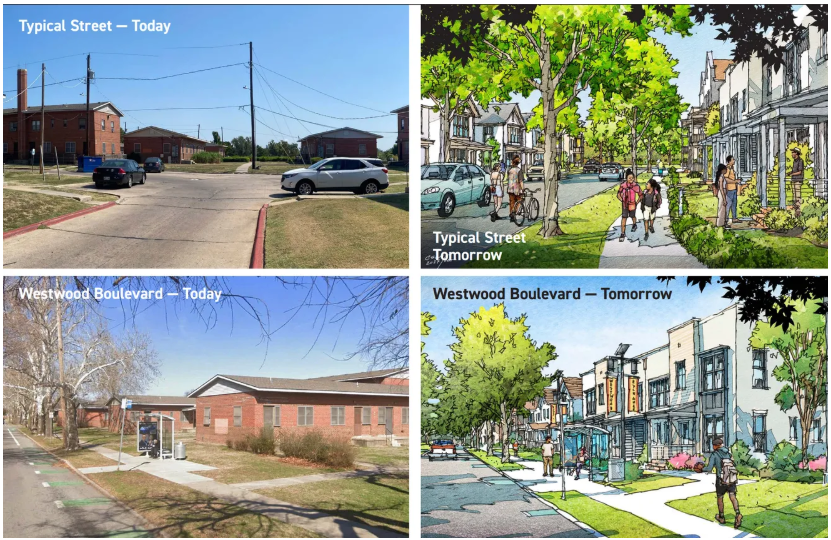
The plan is meant to transform the Will Rogers Courts neighborhood by redeveloping its public housing into mixed income housing; supporting employment, education, and health; and increasing access to trails, parks, transportation, amenities, and economic development.
People living at Will Rogers Courts are among the poorest in the city, with many of them making virtually no annual income and lacking reliable transportation. The complex was under scrutiny in mid-2024 after three fatal shootings occurred within six days at the location, but housing officials and planners say that increasing access to social programs and deconcentrating the effects of poverty onsite will give the residents better opportunities.
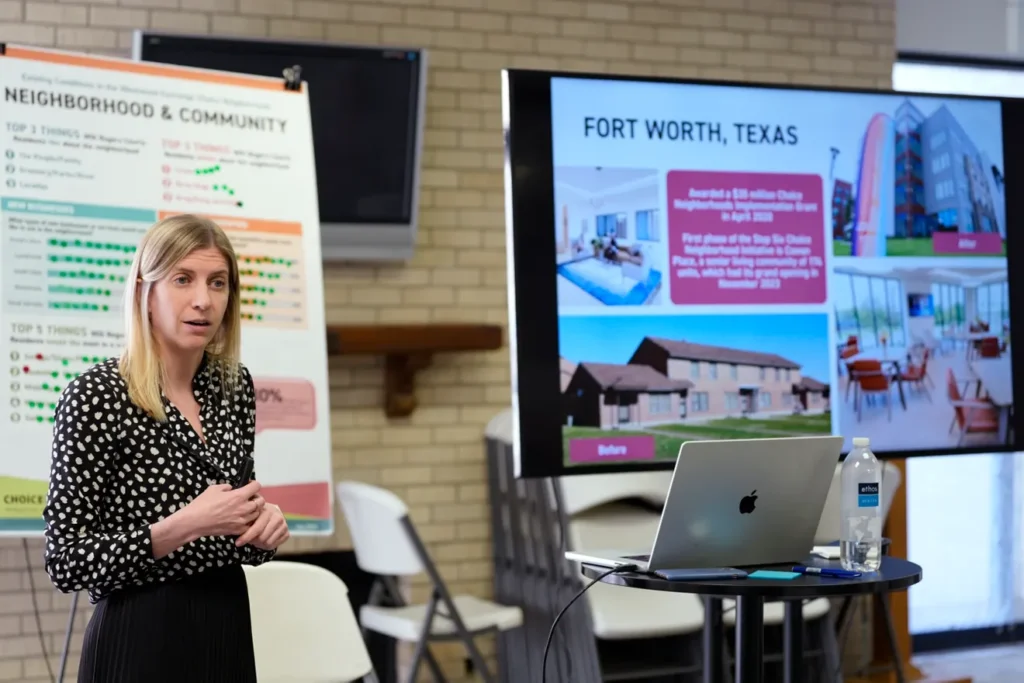
“It’s currently obsolete in terms of the layout and the functionality of the housing,” said Megan O’Hara, principal and CEO at the Pennsylvania-based Urban Design Associates. “But the whole point will be, you can’t look at it and know where people with low incomes are living. It will just feel like a beautiful apartment community with nice amenities and will feel like a real neighborhood that people choose to live in.”
Partners for the project had secured Choice Neighborhoods funding a few years ago to begin official research toward developing the plan through 2024 and 2025. That involved Community Action Agency and Lilyfield partnering with the city’s housing agency on facilitating residential feedback sessions and securing supportive services onsite to better serve the community.
It now is expanding to include Brinshore Development, a major Illinois-based affordable housing leader recognized nationwide that has been tapped to help build new mixed-income units at the site.
“The application’s actually due on March 9, but we’re submitting on March 5 because we don’t want to deal with any technical difficulties and we’re ahead of the game,” O’Hara said.
What does the plan entail? How long would it take to complete?
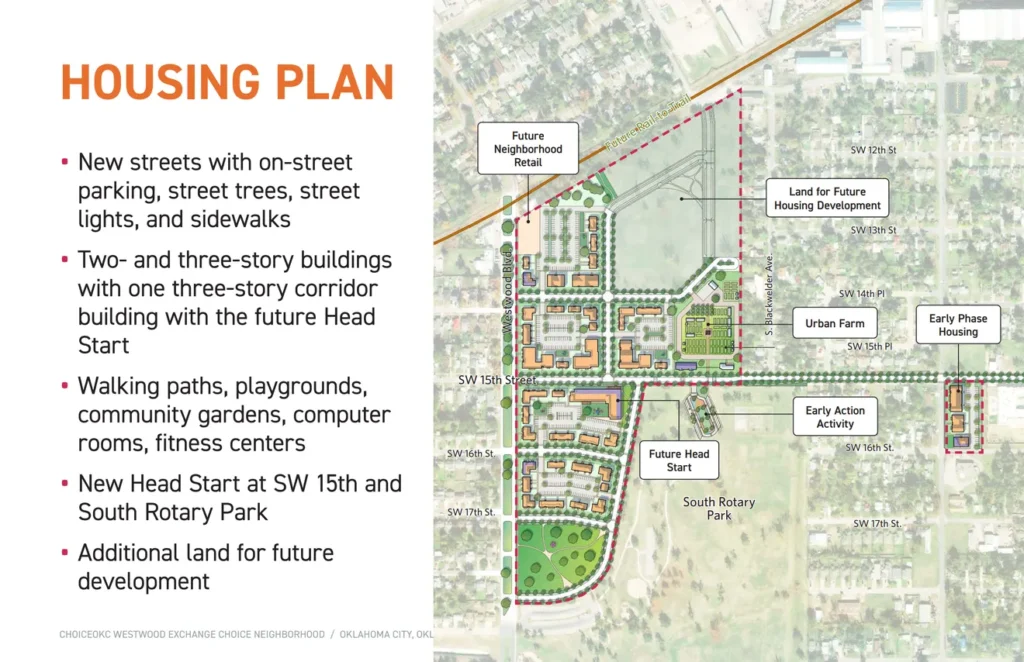
The project would mean demolition and reconstruction occurring in phases. A possible build-first site is already eyed for vacant land behind Western Gateway Elementary, where planners hope to construct up to 36 mixed-income units.
The second phase of construction could then frame SW 15th Street with 144 units, after which the third phase would move south. That next phase would bring 61 units along Westwood Blvd. between SW 16th and SW 17th streets, with South Rotary Park directly east of them.
The fourth phase would entail another 144 units along Westwood, surrounded by both future retailers and a planned urban farm nearby, while some land is left open for potential housing development later. One three-story corridor building is also planned to anchor the expanded Head Start program near SW 15th and South Rotary Park.
Development would also include new streets with on-street parking, trees, lighting, and sidewalks. It also would include walking paths, playgrounds, community gardens, fitness centers, and computer rooms.
The overall plan is expected to take 8 years, but designers said they are “still several years away” from the first residents having to relocate.
“We wanted everyone to understand that if we win the grant, everyone will have to move because we’re not renovating the units ― we’re demolishing and getting rid of them and building new ones,” O’Hara said. “But it’s important that people understand that it’s phased.”
Families would be supported by case managers and housing specialists to help them find appropriate housing either temporarily or long-term. They would also be eligible for first right-to-return once the apartments are up, with one move away and one move back to the new housing paid for. Developers also pledge that the right-sized unit will be provided to meet family needs for bedrooms and accessibility.
The build-first site adjacent to the school would allow for new housing before any existing units are demolished onsite, O’Hara said.
In addition, the city is converting a vacant rail corridor into a pedestrian and bike trail. Designers believe the intersection of Westwood Boulevard and the new trail could be an ideal location for businesses and amenities.
SW 15th Street would connect the Westwood Exchange neighborhood to the Wheeler District’s shops and restaurants and Western Avenue transit stops.
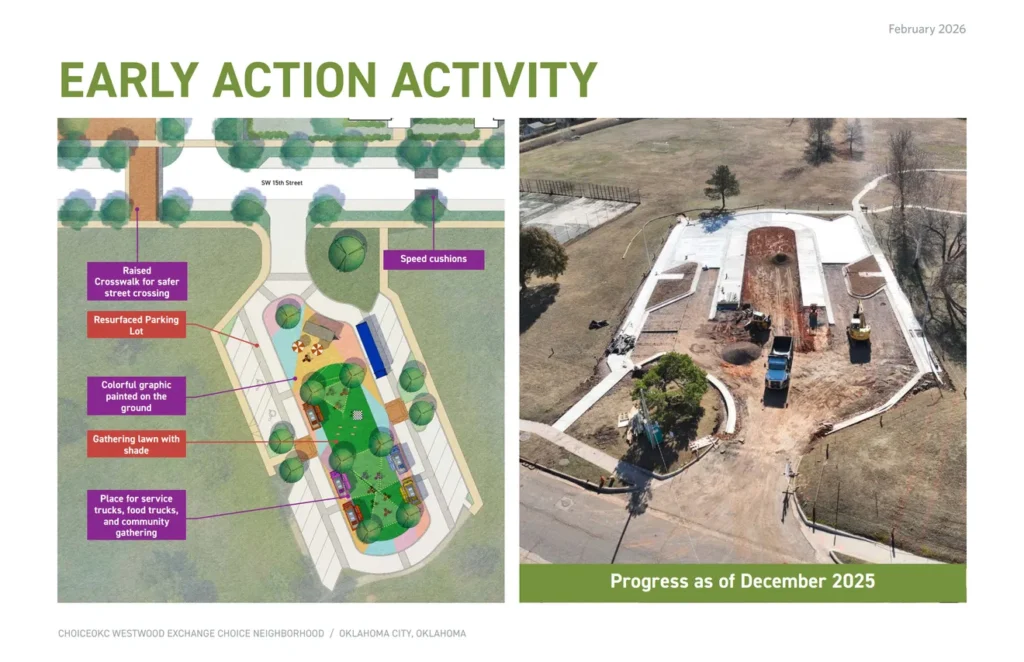
Planners also already have made early progress on a small plaza connected to SW 15th Street, set to include a resurfaced parking lot, a ground mural, a lawn with trees, and a community gathering space for food trucks.
The Westwood Exchange Neighborhood gateway is meant to be highly visible at the intersection of Westwood Blvd and Exchange Ave. Planners hope to work with the Stockyards City neighborhood and other communities surrounding Rotary Park to design an entrance with striking visual aesthetics.
The gateway, meanwhile, will lead directly into a three-acre urban farm north of SW 15th Street. Operated by Lynn Institute, it would offer both seasonal and full-time job opportunities.
What do city leaders have to say about the project?
Greg Shinn, an assistant executive director at the Oklahoma City Housing Authority, said the application opportunity’s timing was perfect, as the funding from the previous grant to develop the plan was winding down.
He said he is appreciative of the various community partners stepping up to also commit leveraged dollars toward the vision of revitalizing the whole southside area, which has historically seen a lack of investment.
“So many other parts of the city are thriving and flourishing because of MAPS and other investments, and this part of the city really deserves that same kind of attention,” Shinn said. “You’re looking at the No. 1 trading cattle market in the world, and right over here is all of this poverty. I mean, you’ve got a thriving community like Wheeler, and meanwhile this is just hidden. We just really really need to drive investment to this part of the city, and it’ll take off just like the other parts of the city.”
Oklahoma City Councilwoman JoBeth Hamon ― who represents Ward 6 in which the housing complex sits ― said such a project wouldn’t even have been possible if the city hadn’t made a deliberate effort to activate collaboration with nonprofit partners in the area.
“I think some of the partnerships that have come out of this, even if we didn’t get this initial implementation grant, are creating some opportunity and new energy in this neighborhood in a way that wouldn’t have even happened if we didn’t even have a planning grant,” Hamon said.
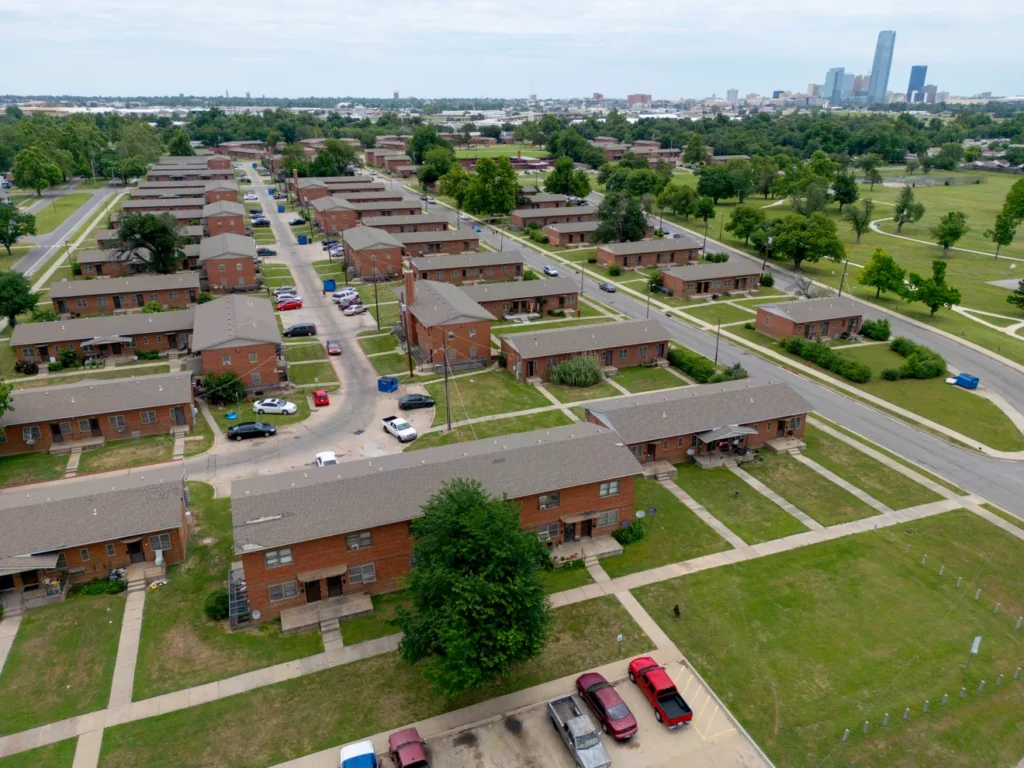
Hamon also acknowledged the structural barriers for the Will Rogers Courts tenants, who average incomes of $5,000 annually and live in Great Depression-era brick-and-concrete units with no central air conditioning and no shower heads. She cited a reporting project from The Oklahoman, Curbside Chronicle and The Frontier, showing that Will Rogers Courts was the oldest stock in the local Housing Authority’s portfolio.
“It’s just the idea that this is the reality for a lot of people, and that we have just sort of let this area languish ― but now it’s exciting that the city has been an active partner in this, and I’m really hopeful that we can kind of come together to support it and keep the forward momentum,” Hamon said.
O’Hara said that, even if they don’t receive the funding for which they apply, the Westwood Exchange project partners will regroup and pursue other means. Either way, they’ll know for sure how they’ll have to proceed in a matter of months.
“We will find out if we made the shortlist sometime in the summer and hopefully moving into implementation towards the end of the year or early next year,” O’Hara said. “It’s a pretty quick process when it comes to the grant. If we get it, we’re going to be running for eight years.”